

Bodies without needs

For the erotic is not a question only of what we do; it is a question of how acutely and fully we can feel in the doing. —Audre Lorde
By the time I was old enough to notice sex1, it had already been fully integrated into the logic of how I was supposed to exist in the world. Sex was everywhere, which meant, functionally, that it was nowhere in particular. Women’s bodies were easily accessible, from porn to magazine covers to social media, offering an endless catalog of women positioned both for consumption and imitation, until the distinction between being looked at and learning to look at yourself collapsed entirely. Eroticism, as we understood it, had become as mandatory and unremarkable as the air.
People like to say my generation is becoming increasingly regressive about sex2. Apparently, we’re confused, prudish, and ungrateful for the spoils of the sexual revolution that the generations before us had fought to secure. But I think what’s missing from this narrative is context. I’ve never viewed our relationship to desire as “confused” at all; rather, I feel we’re responding rationally to the specific conditions we grew up with. We inherited a world where liberation did not deliver us to some promised land of erotic freedom but to something stranger and even more exhausting. The sexual revolution succeeded in making sex unremarkable, in stripping it of the danger and transgression that once gave it cultural potency. In earlier eras, eroticism had a function — it meant to transgress, to liberate, to shock, to express something that couldn’t be said otherwise. Even when that function was oppressive (and it often was), it at least provided structure.
Of course, the loosening of sexual repression was necessary and good, but the patriarchy is opportunistic. It survives not by clinging to one mode of control, but by convincing women that the disappearance of one form of repression means the disappearance of repression altogether. That because sex is visible, speakable, everywhere, we must now be living in freedom. In a post-liberation era, the trap is that women are told autonomy is already achieved, and so whatever remains cannot be oppression, only preference (i.e. choice).
When living in the aftermath of liberation, you find that what comes after isn’t always necessarily freedom.
In Mark Fisher’s critique of contemporary capitalism, he describes our current moment as one of “depressive hedonia” — a state in which we continue to pursue pleasure even though that pleasure has ceased to provide any real satisfaction. The contemporary subject (that is, any of us navigating social media or the attention economy or “doomscrolling”) is caught in a loop of pursuing pleasure reflexively, without any real expectation that they’ll actually feel anything. As Fisher writes in Capitalist Realism:
Depression is usually characterized as a state of anhedonia, but the condition I’m referring to is constituted not by an inability to get pleasure so much as it is by an inability to do anything except pursue pleasure. There is a sense that ‘something is missing’ — but no appreciation that this mysterious, missing enjoyment can only be accessed beyond the pleasure principle.
The cruelty of depressive hedonia is in its subtlety. We have endless streams of content, influencer marketing, porn, dating apps, and TikTok trends that all promise the instant, repeatable thrill of satisfaction, while delivering only more chasing. We aren’t denied pleasure outright, but it is rendered incapable of surprising us or of being transgressive in the world that produces it. Fisher’s formulation reframes our desire as an inevitability: we cannot stop pursuing, and yet the thing we pursue does not exist outside the pursuit itself. If satisfaction can only be found beyond the pleasure principle, what does it even mean to live — or desire — in a world designed only to produce endless pleasure without fulfillment?
Depressive hedonia emerges at the intersection of capitalism, technology, and the moral economy of self-optimization. Like anything in the capitalist patriarchy, sexual liberation has been completely consumed by the system and spit back out as a strange alien to what it once meant. Now it’s just like any other commandment of optimization for women: be always hot, available, and endlessly desirable.
The depressive hedonia we feel today goes beyond simply the pleasure we chase through content, but also through our bodies — specifically through attempting to make our bodies perfect. That in itself is an impossible and unreachable kind of pleasure that we can’t help but chase today. Nearly a quarter of adults in America have had at least one cosmetic procedure, and half of them go on to have multiple procedures. It’s not uncommon for women stuck in this cycle of reinvention to express regret, to feel like they need more and more revisions before they can feel truly satisfied with how they look. Because the satisfaction is never the point. The point is the pursuit, the endless labor of becoming.
Few brands have been more responsible for manufacturing the aesthetics of female desirability than lingerie. The cultural significance of Victoria’s Secret and other similar brands is not and was never relegated simply to selling underwear. These brands are who we look to when we want to know what sexiness is supposed to look like in our current cultural moment. And Victoria’s Secret has notoriously sold a very narrow, unattainable, and exclusive vision of beauty. Desire, in the world of VS, was never meant to feel ordinary, it was fantastical. But constant criticism over their exclusionary ideals finally pushed the brand into taking a break from their fashion show and trying to change to fit with modernizing times. As Executive Creative Director of VS, Adam Selman, said: “(I want to work with those) in the zeitgeist and the cultural conversation…[but] I don’t want to ever be heavy-handed about that either — I don’t want to tick boxes.” And they seemed to have technically achieved this with their show last year, which returned with a visibly expanded cast: diverse body types, diverse ethnicities, diverse identities, pregnant women, athletes, influencers, and more.
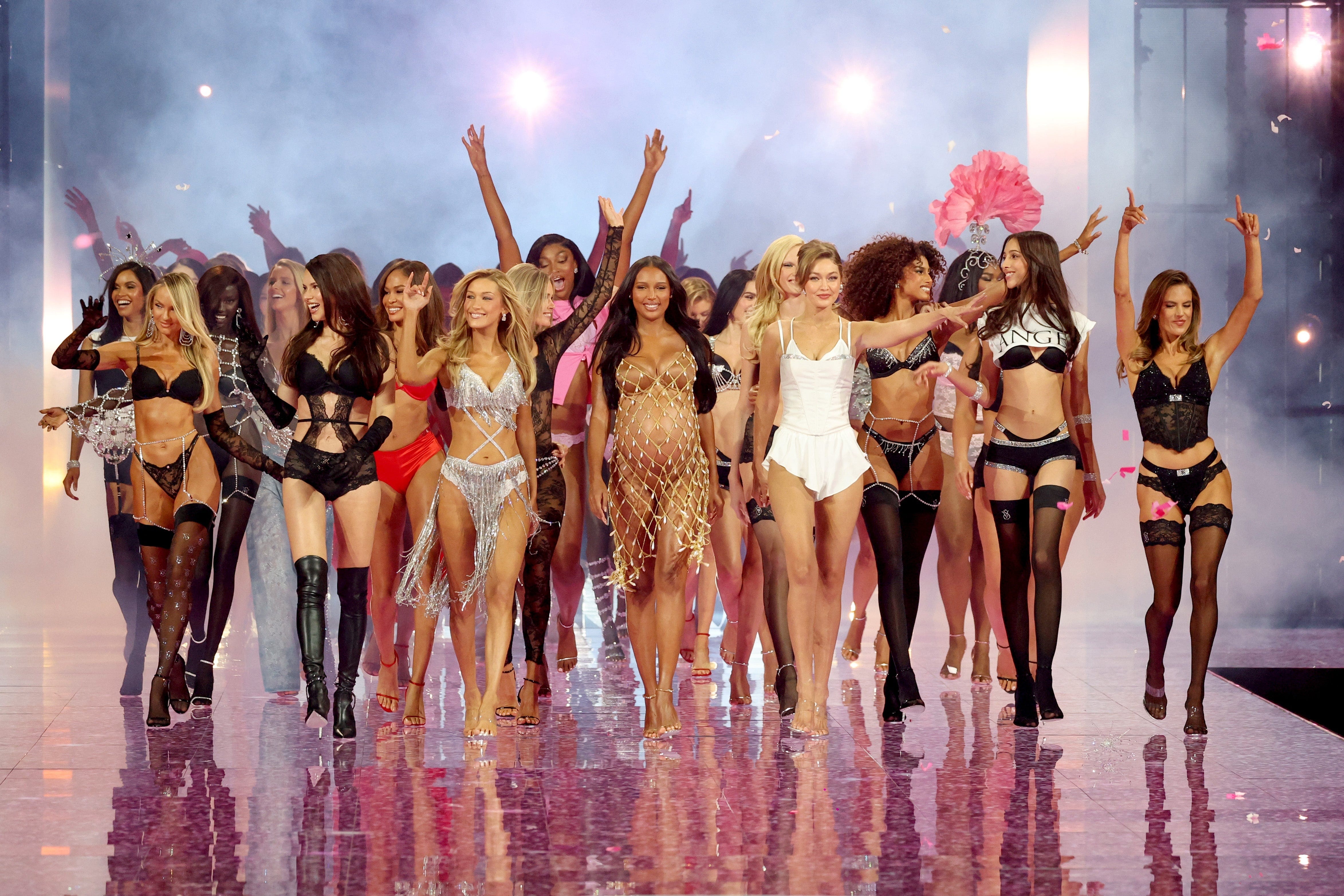
This attempted reinvention is interesting to me not because you can quantifiably decide if it succeeded or failed, but because of the confusion it seemed to generate among viewers. Some felt betrayed, arguing that VS’ whole appeal was the fantasy aspect, and that making it more “realistic” or “inclusive” was stripping away what made the brand so desirable in the first place. These people are among the group who believe that eroticism is supposed to exceed ordinary life. And to make it more “inclusive” was, in their eyes, to flatten it into something mundane. They reached instinctively for words like “boring” and “lackluster,” as if desire itself depends on exclusion to retain its charge.
But others insisted that this is precisely what desire should be now. In a post-sexual liberation era, these people believe eroticism should be accessible and representative of all. Some even argued that the show still wasn’t inclusive enough, and the brand had a ways to go if they wanted to actually reflect changing times. And yet even this “progressive” demand for inclusive eroticism carries its own pressure: it asks desire to function as moral consensus, as if erotic fantasy is something we could ever collectively agree on.
Both positions are technically defensible. And both are asking the female body to do something it structurally cannot do. In a world where nothing is forbidden and where sexual imagery is as ambient and ubiquitous as it is, desire becomes unmoored. What are we supposed to want? Why? Toward what end? Without answers to these questions, we’re left clinging to incompatible ideals, exhausting ourselves trying to embody contradictions that are just the result of capitalism and patriarchy both trying to monetize off of our liberation.
Men, under patriarchy, have always been the subjects of desire: the ones who want. Women are its object: the ones who are wanted. As we navigate through a time of post-sensuality and it seems the patriarchy is increasingly unsure about what exactly they want from women’s bodies, women are still required to be wanted, to figure out how they can fit every contradictory ideal. And so the female body must be simultaneously desirable, diverse, accessible, disciplined, ageless, and authentic. Audiences believe that lingerie models should have bodies that are realistic but also aspirational, show no signs of aging but also not be full of filler or Botox, be diverse enough to encapsulate any ordinary person but also not so ordinary that the show feels boring. Women, trained from a young age to read and respond to the demands placed on our bodies, internalize this impossible project as our own. We were told we could be anything, and now we have to be everything, all at once, forever.
In the absence of repression — or rather, in the absence of external, legible repression — we’ve redirected erotic energy inward. If sex has been stripped of its transgressive power, if desire has been rendered banal by its own ubiquity, then the new frontier of erotic possibility becomes the body beautiful: the sculpted ass, the flat stomach, the plump lips, the clear skin, the ageless face. In a post-sensual world, the body stops being a tool for experiencing pleasure and becomes the site where all of our culture’s unresolved questions about sexuality, power, and liberation play out. We’re less concerned with feeling sexy than with being sexy, which is to say, with being perceived as sexy by others through meeting an ever-escalating standard of desirability. As the baseline keeps rising, the interventions required to achieve it escalate accordingly, which is why the beauty industrial complex has exploded in the exact same moment that we’re supposedly “liberated.” Plastic surgery, injectables, Ozempic, wellness culture, biohacking — they’re all responses to deeper confusion about what desire is now that nothing is forbidden.
The issue is that we’ve become too comfortable. When you tell women they now live in a post-sexual-revolution world, a world “after” repression, we want to believe that narrative so badly that we easily accept it to be the truth. But patriarchy does not disappear; it simply adapts and modernizes to continue to keep women under its oppressive thumb. Women, offered impossible choices within impossible systems, as Dworkin would say, “make the best deal” they can and then convince themselves those deals are victories. The modern woman makes the best deal she can: the deal that promises she will be safe, accepted, and desired within the patriarchy as long as she internalizes that her body is flawed and she must work to make it perfect. The best deal we have is accepting that our bodies are projects in exchange for at least being able to call them ‘ours.’ But the twisted (and unwinnable) logic of this deal is that if your body belongs to you, then its failures are your responsibility as well. Which is how “choice” has become such a difficult weight to bear in our current choice feminist future. When you have access to every possible tool for bodily transformation — makeup, surgery, personal trainers, meal plans, supplements — then you also have the responsibility to use them. If you can choose to be accepted and perfect and desirable, then why wouldn’t you want to be? Why wouldn’t you make everything easier for yourself by just taking the only deal offered to you?
I choose to believe the average woman, even if subconsciously, knows the body-as-project was never meant to free her. She knows it exists primarily to discipline and manage her. But she also knows she’s living in the aftermath of liberation, and it’s the only form of safety she’s been offered. There is no dignity, surely, in following the instructions of a system designed to profit from your labor and insecurities. Yet where would be the dignity in refusing the only shelter available, shivering while the fire that could warm you burns just within reach, and all it requires are a few small compromises?
Throughout this essay, I use the word “sex” to mean many aspects of eroticism or desire. Not just sex in the traditional sense of the word (the action), but also to mean “sexy,” “sensual,” and the many ways desire manifests.
It’s important to note that moral panics around sex are cyclical discussions, as in every older generation has (and will) create narratives about younger generations and the allegedly “unique” issues they have. Even my generation will likely have these same fears about the sex lives of the generations coming after us. It doesn’t mean these fears are necessarily true or even completely accurate.
Yes—this hits hard. Liberation promised freedom, but what we got is a loop: desire everywhere, satisfaction nowhere, and the pressure to perform pleasure as if it’s duty. It’s exhausting, alienating, and so real.
i think a big problem is that we are still transfixed on women being beautiful/desirable, particularly to men, despite being supposedly ‘liberated’. we had the pre-sexual revolution where women had to simultaneously be chaste and conform to their husband’s sexual needs 24/7, post-sexual revolution where we were extremely sexualised and put through narrow ideals to appeal to men, and now this confusing era, where, whether you’re pushing toxic body positivity and spouting that all women are always beautiful always! or still perpetuating those narrow ideals now framed through ‘wellness’…you’re still obsessed with women’s youth, beauty, and sex appeal. why was the response to ‘i dont feel beautiful because i’m old/hairy/not skinny as hell’ ‘oh no you are beautiful i promise!’ and not ‘you don’t have to be beautiful’? is the idea of an ugly woman so terrifying? bodies are inherently gross sometimes. men joke about belching and burping, are allowed to be seen as smart or funny or even attractive BEYOND their looks (the pete davidson discourse a few years ago for example), get to age, gain weight, with no comment. but women must be beautiful always - if they age/gain weight/change they are either critiqued or reassured they’re ’still beautiful!’ without any request for such reassurance. in more mature settings, women also must be sexy all the time, hence sex is everywhere and becomes meaningless. i think the only way out of this system is body neutralit. seeing our bodies as multifaceted vessels that can be sexy and have sex as well as being kind of gross to fulfill other functions. then sex isn’t everywhere always, beauty isn’t forced, and women are (shocker) more than skin deep. but the shallow idea that we are liberated after one liberation movement as you highlighted prevents this.
a great read by the way!